

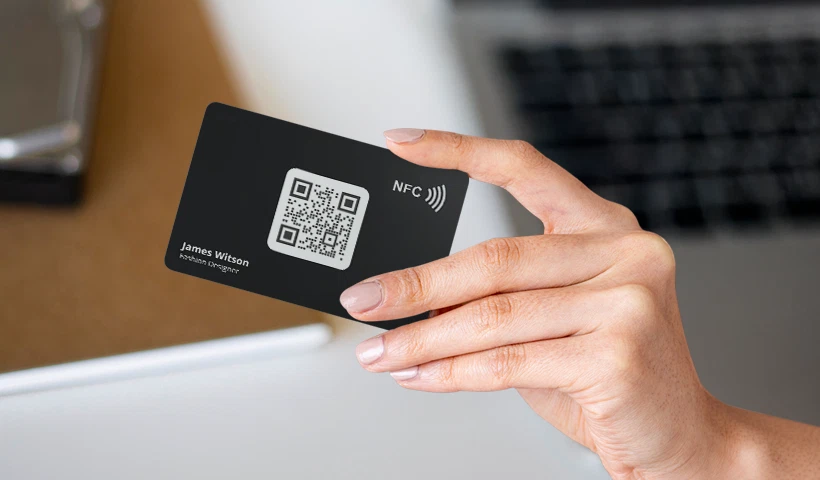
An NFC business card works better for fast, one-tap sharing in person, while a QR code business card works better when the other person is at a distance or the phone does not support tap technology. The real answer to nfc business card vs qr code business card depends less on which is newer and more on how and where the card gets used.
Both formats solve the same core problem. A printed card only holds static text, but a digital card needs a way to move from one phone to another without manual typing. Near field communication and QR scanning are simply two different paths to the same destination, which is a saved contact and a shared profile.
How an NFC Business Card Works
An NFC business card uses a small chip embedded in a card, phone case, or wristband. When two phones come close, usually within a few centimeters, the chip transfers the contact profile automatically, often without the receiving person opening a camera app at all. This tap to share contact card method feels closest to the instant, physical exchange of a paper card, just without the paper. Most modern smartphones support NFC by default, though a small number of older Android models and some budget phones need NFC turned on manually in settings.
How a QR Code Business Card Works
A QR code business card prints or displays a scannable pattern that any phone camera can read. The person opens their camera, points it at the code, and taps the link that appears, which opens the digital profile. This method does not require the two phones to touch or even be close, since a QR code can be scanned from a screen, a printed flyer, a booth banner, or a name badge from across a table. Smartphone compatibility is close to universal here, since every phone with a working camera can scan a code without any special hardware.
Speed vs Reach: The Real Trade-Off
NFC wins on speed in a direct, one-on-one exchange. A tap takes under a second and needs no camera app, no steady hand, and no lighting. QR code wins on reach, since it works at a distance, on a screen, or printed on materials distributed to a room full of people at once, like a conference badge or a presentation slide. A contactless networking card that leans on NFC alone can struggle in a large group setting, while a QR-only card can feel slightly slower in a quick, casual handshake moment.
Many professionals now solve this by using a hybrid nfc qr card, one card carrying both the embedded chip and a printed code, so it adapts to whichever exchange happens naturally. If you want to try a card built around this hybrid model, ShareEcard supports both tap and scan sharing on the same digital profile.
Cost and Setup Differences
An NFC card usually costs a bit more upfront because of the embedded chip, and it needs to be reprogrammed or reissued if contact details change dramatically, depending on the platform. A QR code card costs less to produce since it is just a printed pattern linked to a digital profile, and the underlying page can be updated at any time without changing the code itself. For a team rolling out digital business card for networking across many employees, the ongoing simplicity of QR often makes it the easier starting point.
Which One Should You Choose
Sales reps working trade show floors, where fast one-on-one exchanges happen constantly, often lean toward NFC for the speed. Marketers, event organizers, and anyone distributing contact details to a group at once tend to lean toward QR for the reach. Contactless data exchange matters in both cases, but the setting decides which format performs better on any given day.
FAQs
Do I need a special app to use an NFC business card? No. Most phones read an NFC tap through built-in settings, though some cards link to a webpage that opens automatically without requiring a separate app.
Can a QR code business card be scanned from a phone screen, not just print? Yes. A QR code business card can be scanned directly from another phone’s screen, which makes it useful for video calls and virtual meetings, not only in-person events.
Is one format more secure than the other? Both are similarly secure for sharing basic contact information, since neither transmits sensitive personal data unless the card owner chooses to include it on the profile.
The nfc business card vs qr code business card decision is not about picking a winner permanently, since a well-built digital card can offer both and let the situation decide which method gets used.
